
News, events
Event

Sustainable Finance in European Jurisdictions
The necessary path to a carbon-free economy will only be achievable with a fundamental transformation of essential sectors. Above all, there is a need to channel private capital into sustainable enterprises. The acceptance of this epoch-making project depends on the coherence of the legal framework to be created. So far, there are mainly regulations that can […]

Event
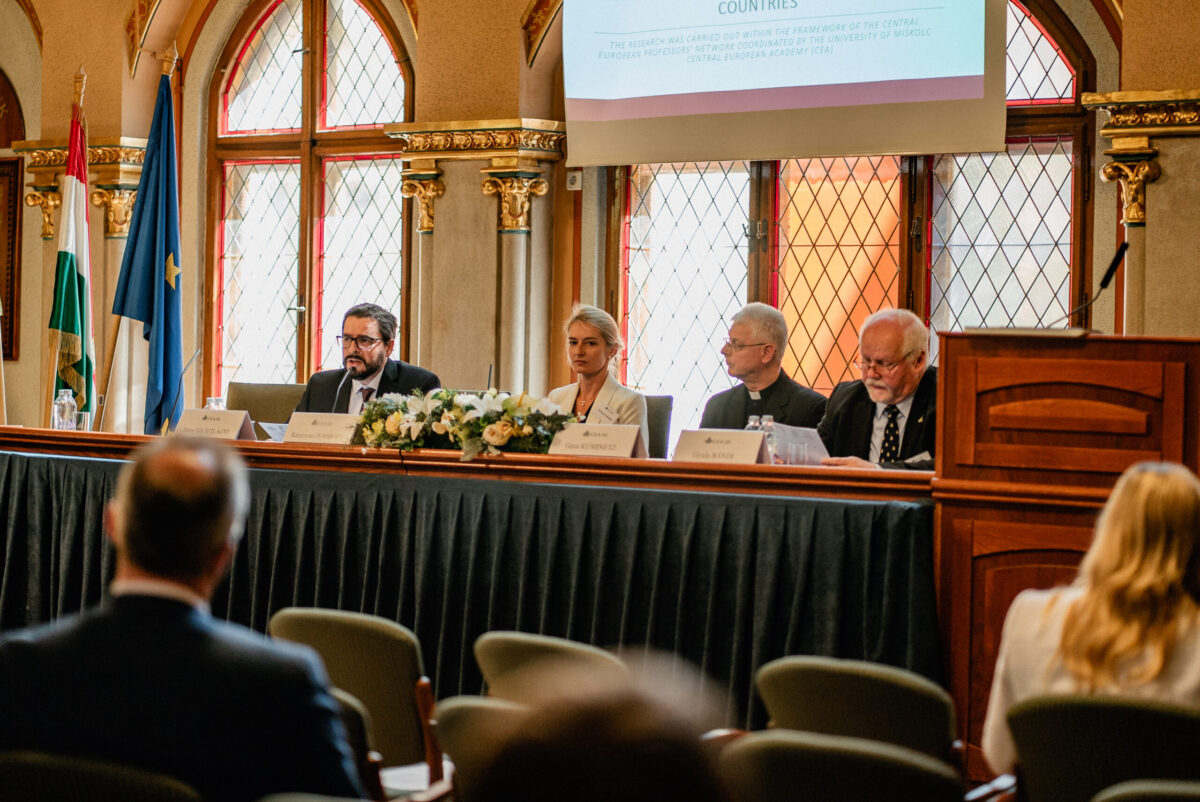
Constitutional framework for the protection of future generations and the environment in the regulation and jurisdiction of certain Central European countries
A conference was presenting the work of the research group “Constitutional protection of the environment and future generations“, led by Prof. Dr. János Ede Szilágyi, head of the Ferenc Mádl Institute of Comparative Law, was held on 26 May. Organizer: University of Miskolc – Central European AcademyCo-organizers: Pázmány Péter Catholic University Faculty of Law and […]
Event

Keynote discussion on launching the Conference on the Future of Europe
On June 25 2020, the Ferenc Mádl Institute for Comparative Law and the Ministry of Justice co-organized an online conference, called Keynote discussion on launching the Conference on the Future of Europe. The topic was the expectations of the series of conferences on the future of the EU, with special emphasis on the expectations of the Member States.
Event
The Conference in Memory of Itsván Szászy
The Conference in Memory of Itsván Szászy, scheduled for spring but postponed for unfortunate reasons, was held on 16 September 2020 in the Reading Room of the Hungarian Academy of Sciences.
Under unusual circumstances,observing the epidemiological regulations, we were able to listen to lectures of highly qualified law professors, which presented some details of the work of István Szászy.
Event
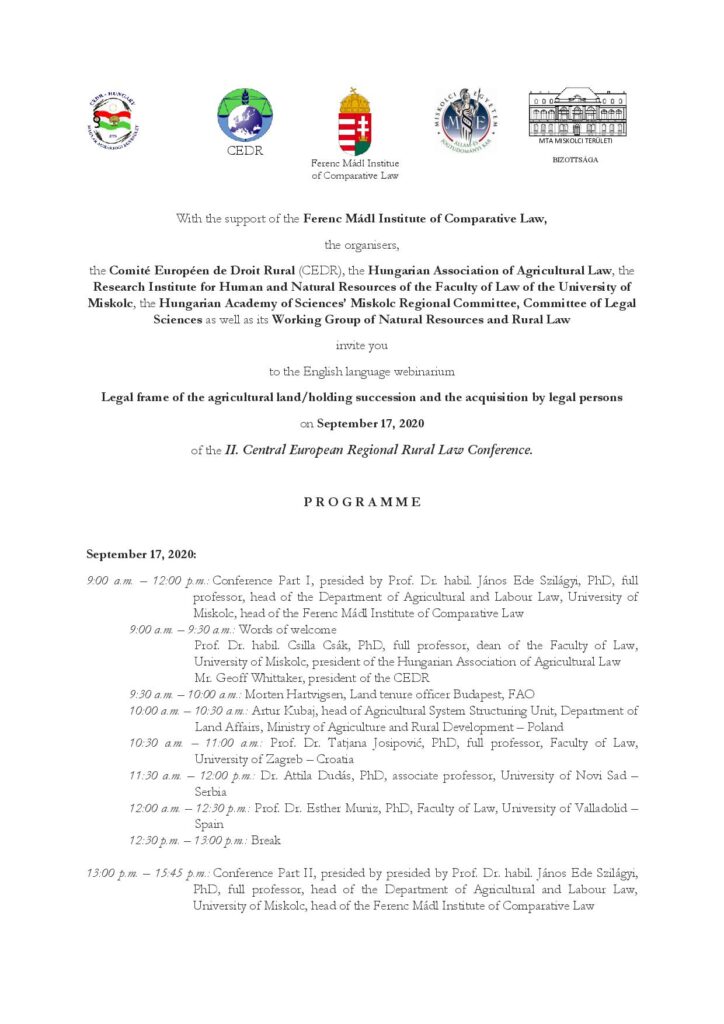
II. Central European Regional Rural Law Conference
The second conference of the Central European Regional Rural Law Conference series, launched by CEDR-HAAL (Hungarian Association of Agricultural Law), was hold on 17 September 2020 in the form of a webinarium with the support of Ferenc Mádl Institute of Comparative Law. The webinarium was based on two topics, on one hand, on the transfer of holdings between generations and the succession of agricultural holding/land, on the other hand, on land acquisition by legal persons.
Event
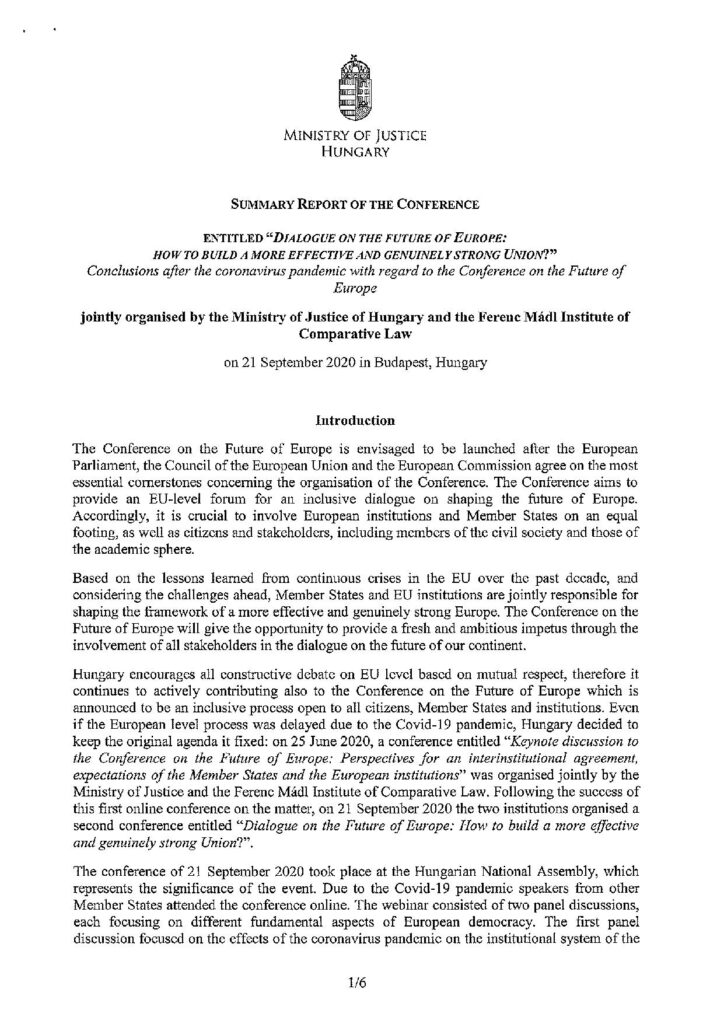
The Dialogue on the Future of Europe: How to Build a More Effective End Genuinely Strong Union
The Ministry of Justice and the Ferenc Mádl Institute of Comparative Law co-organised the conference, called The Dialogue on the Future of Europe: How to Build a More Effective End Genuinely Strong Union which was held on 21 September 2020 in the Delegation Hall of the Parliament.
Event
Interpretation of Human Rights in the Judiciary of the Constitutional Court of the Slovak Republic
The Central European Professors’ network, with the active participation of experts from seven countries (i.e. Czech Republic, Croatia, Poland, Hungary, Serbia, Slovakia, and Slovenia), organises events with the primary aim of drawing the attention of European citizens to significant topics concerning the future of Europe, with a focus on Central Europe.
Event
“NEGATIVE MEINUNGSFREIHEIT”? – Reaction to falsifying history by using the phrase ‘Polish death camps’ in media
Discussions focused on complex legal issues originating from the following recent Polish and German judgments; the 22 December 2016 and 23rd March 2021 judgements of the Court of Appeals in Cracow, the judgement of 19 July 2018 of the German Supreme Court, rulings of the lower instances, and the opinion of the CJEU Advocate General delivered on 23 February 2021.
Event
Religious symbols in the public sphereand the secularity of the state
Religious symbols are present all around us: on state flags, emblems and official insignias, in classrooms, public offices, courtrooms, mass media, hospitals, and public transportation. One could state that wherever there are people, there is a symbol with religious roots. In the past three decades in Serbia, religious symbols—and religion itself—have become an inherent part of the public space. In this case, ‘public space’ should be defined in the broadest of terms to include state and public institutions and all spaces outside of the private sphere and the inner domain of religious organisations.
Event
The impact of digital platforms and social media on freedomof expression and pluralism
The three main lines of thought regarding freedom of expression include (1) recognition of truth as a prerequisite to social development, (2) freedom of expression as an instrument of democratic self-government, and (3) freedom of speech as a value in itself. The speaker further elaborated on the concept of ‘speech’, especially in the digital/online context.
Event
Polish marriage law in the context of social changes and evolution of law in Europe
The event was attended by the staff members and the students of the Faculty of Educational Studies. The lecture was tailored in such a way as to render legal issues understandable to the audience who was not composed of lawyers. Since participants of the webinar deal with family issues in a pedagogical context, this is why legal considerations were presented in a broader cultural context so as to reveal their social background. The aim was to make the issues raised in the webinar more accessible.
Event

The impact of digital platforms and social media on freedom of expression and pluralism – in general terms
The International Scientific Conference “The impact of digital platforms and social media on freedom of expression and pluralism – in general terms” took place in Warsaw, which was organised within the Central European Professors’ Network 2021 by the Institute of Justice in Warsaw, in cooperation with the Ferenc Madl Institute of Comparative Law and the European Association for Comparative Law.