Event

Event

Laudato TV interview about the Central European Professors’ Network

The interview was about the Central European Professors’ Network with prof.dr.sc. Davor Derenčinović, “Izdvojeno”.
Introduction to the Central European Professors’ Network. Information about its activities and deliverables in general, and in particularly regarding the research focus “The impact of digital platforms and social media on freedom of expression and pluralism.”  The discussion was focused on the following issues…

Event

Freedom of conscience and religion in Europe

The event was organized within the framework of the Central European Professors’ Network (coordinated by the Ferenc Mádl Institute of Comparative Law in Budapest) and was hosted by Prof. JUDr. Mgr. Vojtech Vladár, PhD., member of the Central European Professors’ Network who works at the Faculty of Law of the Comenius University in Bratislava.

Event

Marriage, Cohabitation and same-sex partnerships in Slovenia, Croatia, and Serbia

Marriage is a legally regulated life partnership of husband and wife, who, with mutual respect, family relationships, mutual emotional attachment and joint work, form a more effective social cell for socialization. Our law recognises as marriage only the life of two people of different genders. In addition, in order to marry, it is necessary that the persons to marry consent and to declare their consent before the competent national authority.

Event

Religion and State in Slovenia with special regard to religious education and use of religious symbols in the public sphere

The lecture consisted of a comprehensive report regarding Slovene model of state-church relations with special regard to religious education and use of religious symbols. Slovene society cannot be described as particularly multicultural or heterogeneous. Compared to a number of other European countries it can be considered virtually homogenous.

Event

Methodological issues in human rights/fundamental rights jurisprudence

Fundamental rights are becoming more and more important not only in law but also in everyday life. The protection of fundamental rights is provided by a growing number of bodies with different competences, the most important of which are those performing administration of justice.

Event

Foster care and adoption

The aim of the meeting was to present the characteristic features of foster care and adoption and to show that – though they are often confused and mistaken by the public at large – from the legal point of view they constitute two different forms of care over children. It is necessary to have a clear picture of the distinction between them to apply them correctly.

Event

The impact of digital platforms and social media on freedom of expression and pluralism

During the webinar Professor Dušan Popović analyzed the legal status of those online comments that may threaten the reputation of a person, from a freedom of speech perspective and within the auspices of European law. These comments typically appear as anonymous statements, signed only with a ‘nickname’ not allowing for identification of a poster.

Event

Actual Topics of State Ecclesiastical Law

The dissemination event was an international conference, where I presented the results of my research within the framework of the Central European Professors’ Network coordinated by the Ferenc Mádl Institute of Comparative Law.

Event

Local and national characteristics of family protection in Central Europe

The Central European Professors’ Network, consisting of four research groups, launched its activities on 1 January 2021 to conduct research on a great variety of issues with regard to seven Central European countries (Hungary, Poland, Czech Republic, Croatia, Slovakia, Slovenia, Serbia). The Professors’ Network organises events with the primary aim to draw attention of the European citizens to the topics which are important and significant in connection with the future of Europe, in particular of Central Europe. 

Event

The impact of digital platforms and social media on freedom of expression and pluralism

The Central European Professors’ Network, consisting of four research groups, launched its activities on 1 January 2021 to conduct research on a great variety of issues with regard to seven Central European countries (Hungary, Poland, Czech Republic, Croatia, Slovakia, Slovenia, Serbia). The Professors’ Network organises events with the primary aim to draw attention of the European citizens to the topics which are important and significant in connection with the future of Europe, in particular of Central Europe. 

Event

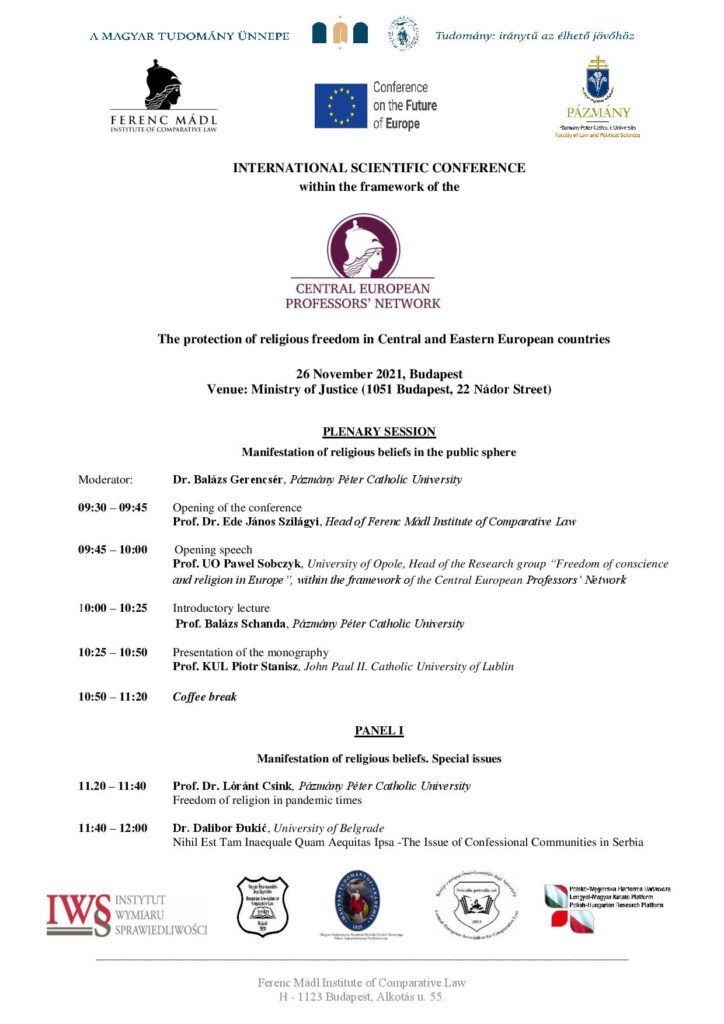
Manifestation of religious beliefs in the public sphere

The Central European Professors’ Network, consisting of four research groups, launched its activities on 1 January 2021 to conduct research on a great variety of issues with regard to seven Central European countries (Hungary, Poland, Czech Republic, Croatia, Slovakia, Slovenia, Serbia). The Professors’ Network organises events with the primary aim to draw attention of the European citizens to the topics which are important and significant in connection with the future of Europe, in particular of Central Europe. 

Event

The case law of the European Court of Human Rights and the European Court of Justice with regard to the East-Central European countries

The Central European Professors’ Network, consisting of four research groups, launched its activities on 1 January 2021 to conduct research on a great variety of issues with regard to seven Central European countries (Hungary, Poland, Czech Republic, Croatia, Slovakia, Slovenia, Serbia). The Professors’ Network organises events with the primary aim to draw attention of the European citizens to the topics which are important and significant in connection with the future of Europe, in particular of Central Europe.